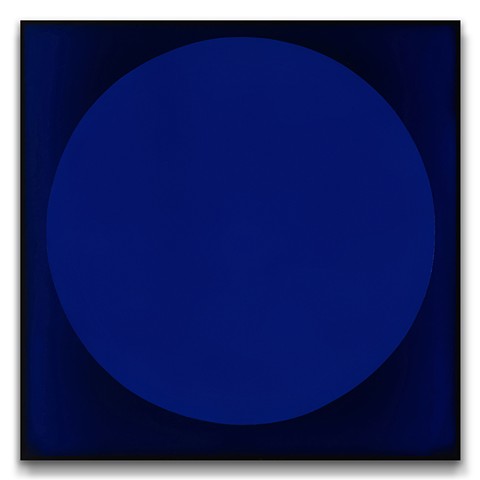
A button a black hole
The circle has long been a symbol of cycles, movement, and meaning - representing everything from the passing of time to the mysteries of the universe. In A button a black hole, Auckland-based artist Hamish Haldane explores this potent shape, balanced between the everyday and the enigmatic.
Putting significance in a circular emblem is not a new concept. Many cultures and societies, past and present, see significance in the circle as a potent symbol for cycles or processes, both momentary and momentous. The ebb and flow of the seasons, departure and return, time, tides, life and death, good and evil, day and night -think of your own life and the cycles that you inhabit, both knowingly and unknowingly.
For Haldane, the circle is fertile ground for personal and universal exploration of form, perception and symbolism.
At the same time, his painted circles, slightly offset in a cast acrylic square, can be seen as completely banal, hence the title of this series — A button a black hole. Is it just a button that you push to call an elevator? Or something you use to hold your clothes in place - is it as simple as a button or as unknown as a black hole?
It’s this paradoxical interpretation between the utilitarian and universal symbolism that intrigues and inspires his work.
"The work is intentionally non-objective and minimalist, and because of that it doesn’t give you answers. These paintings however carry as little or as much meaning as the individual brings to them. The deliberate use of a reflective surface is intended to draw the viewer and their surroundings into this conversation."
Haldane is an Auckland based artist who has exhibited in both solo and group exhibitions. The content of his practice has become increasingly minimalist in content over time through considering the deeper than simply conscious possibilities of forms. His work is held in private collections in New Zealand, Australia, Hong Kong, France and The Netherlands.
As a minimalist he aligns more closely with what Art Historian Kirk Varnedoe would call “East Coast” minimalism, or a group of minimalist artists such as Robert Irwin and Agnes Martin who believed that in reducing their art to its most essential elements it could act as a medium to a more reflective, spiritual experience or a type of meditation. In contrast, “East Coast” minimalists such as Donald Judd, Carl Andre and Jo Baer saw their works first and foremost as material, physical objects, so ‘what you see is what you get’.